-
Bus, Min Bus
-
5,895 Meters (19,340 Feet)
-
High Altitude Camping
-
Easy to Moderate
-
Moshi/Arusha Town
-
Kilimanjaro Airport (JRO)
-
June to October
-
Hiking
-
English, French, Swahili
-
All meals during the trek
-
2 to 25
-
12
-
75
Overview
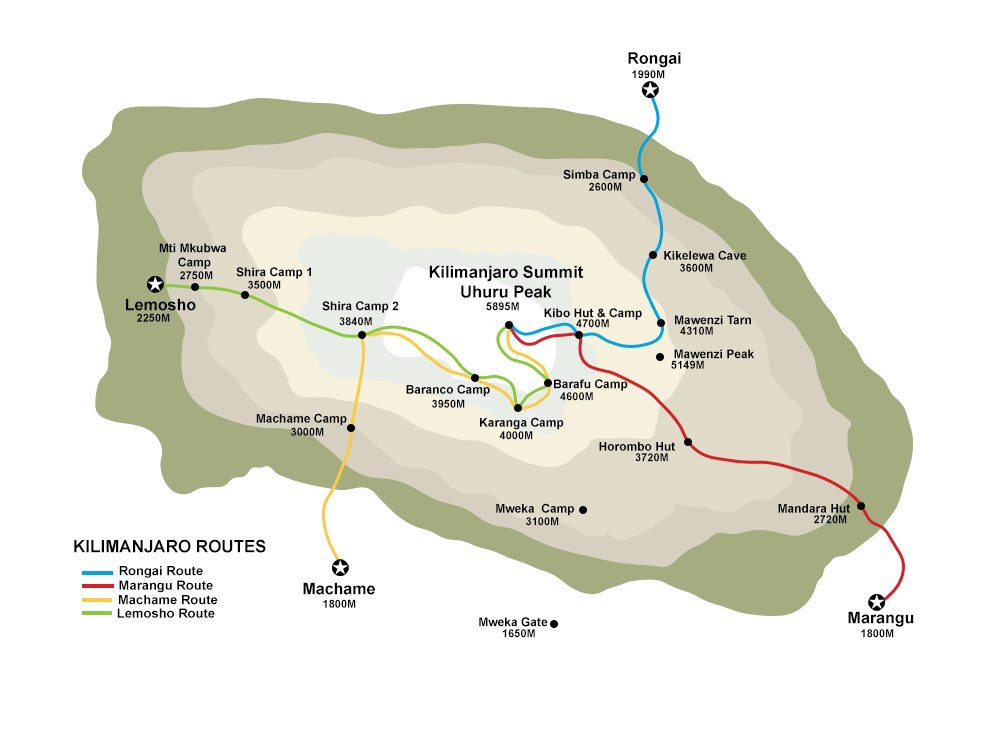
The Rongai Route is the only trail that starts from the Northern, or Kenyan side of Mount Kilimanjaro. Because of its remote location the route offers trekkers a relatively unspoiled wilderness experience.
The Rongai Route is the only trail that starts from the Northern, or Kenyan side of Mount Kilimanjaro. Because of its remote location the route offers trekkers a relatively unspoiled wilderness experience where it is possible to see large wildlife like antelope, elephant and buffalo. The North-East side of the mountain gets significantly less moisture than the southern slopes which means that trekkers are less likely to encounter rain. Trekkers are also more likely to get clear, unclouded views of the mountain. The Rongai Route is flatter than the other Kilimanjaro routes but because of its profile it does not offer trekkers good options to climb high and sleep low. It can be hiked on a six, seven or even eight day. The seven or eight day Rongai routes are highly recommended as trekkers have extra days to acclimatize.
Summit night from Kibo Hut is steep and follows the same path taken by Marangu trekkers which passes Gilman’s Point to Uhuru Peak. Due to its remote setting the Rongai Route receives the least traffic of all the routes on Kilimanjaro and descends via the Marangu trail. Seven and eight day trekkers usually spend an additional day at Mawenzi Tarn (4,300 meters) to acclimatize. Eight day trekkers also stop on day two at Rongai Second Cave (3,450 meters) before proceeding to Kikelewa Camp (3,600 meters).
Highlights
- Quieter, wild northern approach from the Kenya side with fewer crowds
- Excellent views of Mawenzi Peak, Kibo crater, and the Amboseli plains
- Gentle gradients and steady acclimatization with a night at Mawenzi Tarn
- Dramatic “lunar” crossing of the Saddle between Mawenzi and Kibo
- Summit at sunrise via Gilman’s/Stella Point to Uhuru Peak (5,895 m)
- Different scenery on descent via the Marangu route (forest to moorland to alpine desert)
Itinerary
Hiking time: 5 hours
Distance: Approximately 8 kilometers
Habitat: Montane Forest
After an early breakfast at your hotel, you will be picked up from Arusha (1400m) and driven to the Marangu Gate (1980m). At the gate, the porters will organize and pack the belongings for the hike while you and your guide register with the Tanzania National Park (TANAPA). You will then be transferred by vehicle to the Rongai trailhead, which is 2.5 hours away from the Managu Gate. The trail begins in the tall cornfields then leads into the pine forest. This trail has a gradual ascent and allows hikers to enjoy their surroundings. About halfway up the trail you will have a lunch break and you will reach the 1st Caves Camp (2600m) in the late afternoon or early evening. The porters and chef, who move very fast up the mountain, will reach camp before you and set up your tents, boil drinking water, and prepare snacks for your arrival. After washing up, a hot dinner will be served. For overnight, mountain temperatures may drop to freezing so be prepared!
Hiking time: 6-7 hours
Habitat: Moorlands
Following a hot breakfast, hikers will continue their ascent to Kikelewa Cave (3600m). The trail passes Second Cave (3450m) and this is a good spot to take a lunch break. Similar to the first night, your tents will be set up prior to arriving at camp and the porters will prepare drinking and washing water for you. You will enjoy evening snacks then dinner prepared by our chef. Be prepared for a cold night as temperatures drop below freezing at this exposed camp.
Hiking time: 3-4 hours
Habitat: Moorlands
On this day, hikers will enjoy a short, yet steep trail to Mawenzi Tarn Camp (4330m). In the moorland, you will spot exotic plants, including giant lobelia and groundsel. At camp, hikers will enjoy spectacular views and allow their bodies to acclimate. Hot dinner and washing water will be prepared for hikers as they enjoy the magnificent sunset.
Hiking time: 4-5 hours
Habitat: Alpine desert
After breakfast, hikers will continue ascending east for a half-day hike to Kibo Hut. Kibo is located in the “Saddle,” which refers to the area located between the peaks of Mawenzi and Kibo in an alpine desert. There is no water at this camp, but hikers can buy mineral water and soft drinks at the camp office. An early dinner will be served so hikers can rest before attempting the summit the same night. Your guide will brief you in detail on how to prepare for summit night. Get to sleep by 19:00!
Hiking time: 8 hours to Uhuru and 6 hours to Horombo
Habitat: Stone scree / ice-cap summit
Distance: Approximately 6 kilometers ascent and 21 kilometers descent
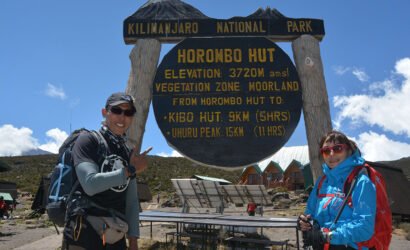
Your guide will wake you around 23:30 for tea and biscuits. You will then begin your summit attempt. The trail is rocky up to Hans Meyer Cave (5150m). You continue your ascent to Gillman’s point (5681m). Reaching this section is an impressive achievement as the trail is steep, rocky, and at high altitude. Gillman’s is located on the crater rim. From this point, you will usually experience a snow covered trail until you reach the summit, Uhuru Peak (5895m). Reaching the summit of Mt. Kilimanjaro is a lifetime accomplishment! You will be able to spend a short time on the summit taking photographs and drinking tea before the descent to Barafu begins. The hike down to Kibo Hut takes about 3 hours.At Kibo Hut, you will rest and enjoy a hot lunch in the sun. After eating, you will continue descending down to Horombo Hut (3720m). You will have a dinner, wash, and rest soundly at the hut after a strenuous day.
Hiking time: 6 hours
Distance: Approximately 27 kilometers
Following a well-deserved breakfast, your staff will have a big celebration full of dancing and singing. It is here on the mountain that you will present your tips to the guide, assistant guides, chef(s), and porters. After celebrating, you will descend for 6 hours back to Marangu Gate (1980m). The National Park requires all hikers to sign their names to receive certificates of completion. Hikers who reached Gillman’s Point (5681m) receive green certificates and hikers who reached Uhuru Peak (5895m) receive gold certificates. After receiving certificates, you will drive back to Moshi in your hotel.
Cost
| Number of People | Price in USD |
|---|---|
| 1 | $2,150 |
| 2 | $1,850 |
| 3 | $1,830 |
| 4 | $1,800 |
| 5 | $1,780 |
| 6 | $1,750 |
| 7 | $1,730 |
| 8 | $1,700 |
| 9 | $1,650 |
| 10 | $1,600 |
Cost
The Cost Includes
- Emergency oxygen
- Airport Transfers
- Hotel Accommodations According to the Itinerary
- All Park Fees
- Helicopter Rescue
- Taxes
- Camping Facilities
- Transfers to and from the park for Kilimanjaro climbers
- Crew salaries
- Sleeping tents
- Professional Guide
- Sleeping Mat
- Meals according to the Itinerary
The Cost Excludes
- Climbing gears
- Meals not listed
- Visa Fees
- Personal expenses
- Travel insurance
- Tips and gratuities
- Personal trekking equipment
- Alcoholic and Soft Drinks
- Flights
- Other Optional Activities
- Mineral water
Frequently Asked Questions (FAQs)
The mountain is in Tanzania, East Africa, about 350km from the equator. The nearest towns are Moshi and Arusha.
Mount Kilimanjaro is the highest freestanding mountain in the world and the highest mountain in Africa. Its highest point is Uhuru Peak on the Kibo crater at 5895m above sea level.
None, but previous hiking or climbing experience will help. You need to be fit and healthy and have a good pair of worn-in hiking boots. The fitter you are the more you are likely to enjoy it.
Getting to Tanzania and hiking up Kilimanjaro is not cheap. But the once in a lifetime experience is worth every penny. Costs (usually quoted in USD) will depend on the tour operator and what you need. Luxuries such as portable toilets and glassware will cost more. Land costs should include transport to and from Kili, full board, porters, guides, cooks, national park fees and permits. Do not choose the cheapest operator, choose an operator who discloses all costs and who offers value for money.
No. There are no hotels on the mountain and no cable cars to the top. You will most probably sleep in tents, or in basic huts if you take the Marangu route. Tents and sleeping mats are carried and set up by the porters. You do need to bring a very warm sleeping bag or rent it from Kilimanjaro-Experience.
On the first day of your climb, you are likely to lose signal before reaching the gate and will not regain it until day two. From then onwards, for most routes, you will find the signal at some point, and sometimes even in camp. On the Rongai route and Northern, Circuit reception can be more limited and tends to be via Kenyan networks, as the routes pass close to the border.
There are no charging stations on Kilimanjaro. You will need battery packs or solar charges to charge electrical items. Please ensure you bring the right cables and keep electrical items warm whilst on the mountain to preserve battery life.
Our crew all receive fair salaries; however, they also rely on the income they receive from tips. Below are standard tipping recommendations to be split between everyone in your group. We prefer you to distribute tips to crew members individually and directly at a ceremony held at the end of your climb. It is a good idea to bring some notes in lower denominations to assist with splitting funds. We will provide a tipping guide with specific crew numbers at your briefing, with envelopes to help you separate money into individual amounts.
| Head Guide: | USD$20 per day |
| Assistant Guide(s): | USD$12 per day |
| Cook(s): | USD$12 per day |
| Porters: | USD$5-7 per day |
In order to help you calculate a rough total tipping amount, we work with ratios of at least one guide per two clients and approximately four porters per client. Please remember porters carry food, gas, tents, etc. in addition to your personal luggage.
Only the Marangu Route goes up and down the same way, which we don’t recommend. Lemosho, Machame, and the Northern Circuit descend via the Mweka Route, which is used only for descent and food re-supply to the camps. Rongai descends via the Marangu Route. Descent routes are more direct, whereas ascent routes pass over ridges and valleys to allow your body to better acclimatize.
Our cooks prepare three hot, nutritious meals daily, as well as snacks and afternoon tea. Delicious vegetarian, vegan, gluten-free and other special meals can be provided. Please let us know in advance. If you would like more details or a sample menu, please ask.
No! We use either a Katydyn filter or water purification tablets to treat the water, making it safe for you to drink. You do not need to bring these yourself. Since the tablets are usually chlorine-based, there can be a slight lingering taste in the water. You can bring neutralizing tablets, electrolytes or flavored cordial/squash to cover the taste.
Additional luggage you do not need to take up the mountain can be left safely in storage at your accommodation or our offices. We recommend you ensure any valuables are signed in to the hotel safe, and where possible left at home!
You are unlikely to come into contact with many animals on the mountain. As the number of trekkers has increased over the years, the animals have retreated. You may see Colobus and Blue monkeys in the rainforest along with a variety of birds. Large white-necked ravens and four striped mice scavenge in camps. Malachite Sunbirds are often seen and heard in the heath and moorland zone and the national park is working hard to encourage native rodents around the Shira Plateau.
At the base of the mountain, average temperatures are 70 to 90°F (21 to 32°C) throughout the year. On the summit, temperatures range from -10 to 23°F (-23 to -5°C) with windchill. Weather is changeable, and you should be prepared for these extremes. Your guide will help you decide on appropriate clothing in a detailed daily briefing.
Weather on the mountain is fairly consistent year-round, but should you plan on attaching a safari to your trek, it’s worth keeping in mind Tanzania’s seasonal shifts. June through October is cooler and drier. December through March is warmer and a bit wetter, with lush, green landscapes throughout the country. We wouldn’t recommend climbing in April, early May, or late November, due to heavy rains.
We generally aim to keep our public group sizes small, usually no more than ten trekkers, to maintain a more personal experience and preserve the feeling of being in the wilderness. However, if you’re booking as a private group, we’re happy to accommodate you regardless of size, as everyone in your group will already be familiar with one another before arriving in Tanzania.
Absolutely! Your Kilimanjaro adventure can be tailored entirely to your preferences. We’ll collaborate with you to craft a personalized trekking experience, designed around your chosen travel companions, ideal departure date, preferred route, hiking pace, and desired duration. It’s your mountain, your way.
We generally aim to keep our public group sizes small, usually no more than ten trekkers, to maintain a more personal experience and preserve the feeling of being in the wilderness. However, if you’re booking as a private group, we’re happy to accommodate you regardless of size, as everyone in your group will already be familiar with one another before arriving in Tanzania.
Although Mount Kilimanjaro is climbable year-round, most hikers choose the dry seasons, from December to March and June to October, for more favorable weather. Among these, January, February, and September are often regarded as the best months for the climb.
You must have a passport valid for at least six months beyond your travel dates, along with a properly endorsed entry or re-entry visa.
Yes, we offer airport transfer services. Kindly send your request to Safari for arrangements.
We manage all operations directly. We are not agents for any third party; instead, we conduct the treks ourselves through our own locally registered Tanzanian company.
On your Kilimanjaro adventure, expert camp porters set up and take down the mountain camps daily. You’ll stay in double-occupancy, all-weather tents equipped with full-ground pads to keep you and your belongings dry. Each camp features private toilet tents, solar-lit dining tents furnished with tables and chairs, and basins of hot water for washing. For those on the Grand Traverse route, accommodations are upgraded to solar-lit, walk-in-height sleeping tents furnished with mountaineering beds and mattresses for added comfort.
Each day, expert chefs prepare three hot, nutritious meals along with trail snacks and afternoon tea. You’ll enjoy your meals in a sunlit dining tent alongside your fellow trekkers and the head guide. We offer delicious vegetarian, vegan, gluten-free, and other specialty options. Just let us know in advance. If you’d like, we can also send you a sample menu, just ask!
Before the climb begins, you’ll have an acclimatization day featuring nature walks and opportunities to observe local wildlife. While trekking through the rainforest, you can expect to see black-and-white Colobus monkeys, various tropical birds, and other fascinating creatures.
On most routes, daily trekking typically lasts between 4 and 7 hours. However, some routes include longer days where you might trek for 10 to 15 hours.
Accommodations
Two Nights’ Hotel Accommodations Before and after the Kilimanjaro hiking adventure, we recommend the following options: Stay two nights with bed and breakfast at Parkview Inn, Panama Garden Resort, Shose Farmhouse and Chalets, Brubru Lodge, or Salinero Hotels.
Map