

-
High Altitude Camping
-
5,895 Meters (19,340 Feet)
-
Kilimanjaro Airport (JRO)
-
June to October
-
Hiking
-
All meals during the trek
-
English, French, Swahili
-
2 to 25
-
Easy to Moderate
-
12
-
65
Overview
Marangu route in 5 days, easiest and shortest route to the summit. This is not always the best way, due to a shorter acclimatization period.
Marangu route 5 days nicknamed the ‘Coca cola’ route, Marangu is the classic and oldest route up Mount Kilimanjaro. It is also the only route where hikers overnight in rustic huts and not in tents, so a good choice in the wet season. The ascent is constant and moderate but the section towards Uhuru peak is difficult. The route follows the same path up and down.
The Marangu route 5 days does however offer you the option of spending an extra acclimatization day on the mountain. This extends the route into a 6-day trek, greatly increasing your chances of success. Shared hut accommodation on the Marangu route forms one of the main differences, compared to the other routes. It offers you the relative luxury of being able to sleep in huts along the entire route. There are 60 bunk beds each at Mandara and Kibo Huts, and 120 bunk beds at Horombo Hut. Mineral water, soft drinks, chocolates and beers are also sold at all the camps on this route. All your equipment and supplies are portered and a cook prepares all your meals. The main itinerary difference between the Marangu 5 day and 6 day routes is the additional acclimatization day at Horombo Hut.
Highlights
- Hut accommodation: Mandara, Horombo, Kibo.
- Trail zones: lush rainforest → moorland → alpine desert.
- Viewpoints: Maundi Crater; panoramas of Kibo & Mawenzi.
- Wildlife & unique flora: colobus monkeys, giant lobelias/groundsels.
- Summit night: pre‑dawn from Kibo via Gilman’s Point to Uhuru Peak (5,895 m).
- Experienced guides, porters, and meals included; best seasons Jan–Mar & Jun–Oct.
Itinerary
After breakfast, you will be collected from your hotel in Moshi and taken to the Marangu gate. Once the necessary paper work has been completed, your trek can begin and you will soon be hiking through the dense rain-forest. Alongside the impressive vegetation, you will have the chance to catch a glimpse of some primates as you head to the Mandara Hut. After a well-earned rest, your guide can take you to the Maundi Crater where you can enjoy the wonderful view of the Kenyan interior.
- Distance covered: 8.3km / 5.2mi,
- Approx. time taken: 5 hours,
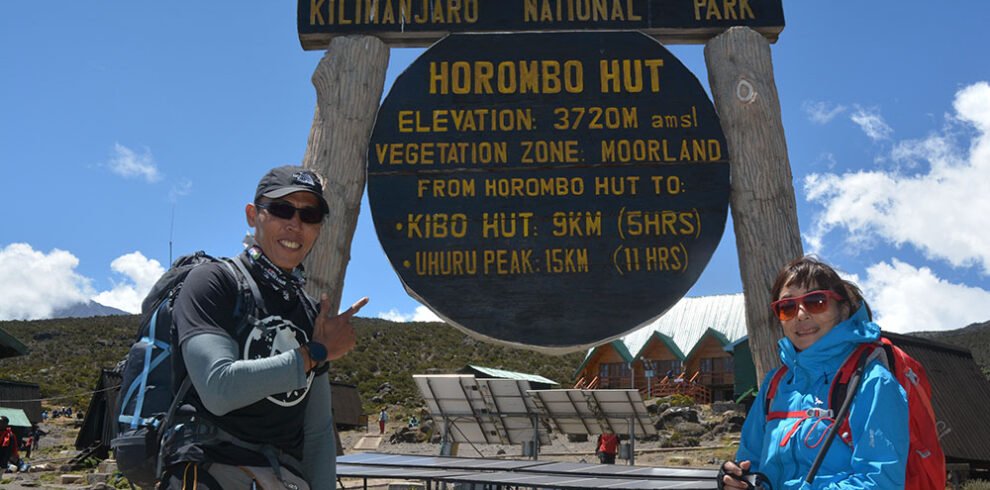
The day begins with an early breakfast. Shortly after you have left Mandara Hut, you will reach the timberline and then enter the heath and moor zone. Approximately 4 – 6 hours later, the Horombo Hut will come into sight, standing at an altitude of 3700m. From the hut, you will have fantastic views overlooking Mawenzi, Kibo and the wide plain of the Masai steppe.
- Distance covered: 12.5km / 7.8mi,
- Approx. time taken: 9 hours,
Today’s stage is long and tough. The well-built trail passes the “Last Water point” which is followed by the so-called “saddle”. This nearly vegetation less plateau joins the main summit Kibo with Mawenzi. Today’s destination is the Kibo Hut that is usually reached in about 5 - 6 hours. Here, you will enjoy an early evening meal followed by an early night, as the night will be short.
- Distance covered: 9.5km / 5.9mi
- Approx. time taken: 7 hours
Today is “The Big Day” - the summit stage. You will begin your final ascent around midnight which will be long and strenuous. Passing the Hans Meyer Cave at 5220m, the climb slowly but surely goes upwards. At sunrise, you will reach Gillman’s Point (5681m) – the crater rim of Kilimanjaro – where the sun will slowly start to warm up the land. You will have soon forgotten the cold of the night and after a further hike of 1 - 2 hours, you will reach Uhuru Peak at 5895m. On your return to Kibo Hut, a warm meal awaits you followed by a 1 - 2 hour break before proceeding back down to Horombo Hut.
- Distance covered: 22km / 13.7mi
- Approx. time taken: 12 – 15 hours
The last stage passes through the heath and moor zone to the Mandara Hut (2700m) where a warm lunch is waiting for you. Soon, you will once again pass the tropical rain-forest and after a total time of 6 hours trekking, you will be back at the Kilimanjaro National Park Gate (1860m). After saying goodbye to your mountain guides, a short transfer follows to take you back to your hotel in Moshi. Once there, you can take a warm and relaxing shower and celebrate your success in reaching the summit of the Kilimanjaro.
- Distance covered: 20.8km / 12.9mi
- Approx. time taken: 8 hours
Cost
| Number of People | Price in USD |
|---|---|
| 1 | $2,000 |
| 2 | $1,850 |
| 3 | $1,800 |
| 4 | $1,750 |
| 5 | $1,700 |
| 6 | $1,650 |
| 7 | $1,600 |
| 8 | $1,550 |
| 9 | $1,500 |
| 10 | $1,450 |
Cost
The Cost Includes
- All transportation in destination location
- Hotel accommodations, before and after the trek
- All government taxes and park entrance fees
- Airport arrival and departure transfers
- All meals while on the mountain
- Tented accommodation on Mount Kilimanjaro
- Emergency oxygen cylinders and oximeters
- Complete expedition medical kits
- Comfortable sleeping mats
- All group camping equipment (sleeping tents, dining tent, table, chairs, crockery and cutlery)
- Portable radios – Taken on every trek to enable convenient communication.
- Dedicated support crew (assistant guides, camp master, porters, chefs, etc.)
- Experienced professional mountain guides
- Salaries for the trekking crew
- Medical evacuations with AMREF Flying doctors
- Purified water while on the mountain
- Portable tented private flush toilet
- Fair and ethical treatment of porters
- Environment-friendly trek
The Cost Excludes
- Personal gear rentals
- Tanzania Visa fee
- Tipping to the trekking crew
- Travel insurance
- Any private expenses
Frequently Asked Questions (FAQs)
Weather on the mountain is fairly consistent year-round, but should you plan on attaching a safari to your trek, it’s worth keeping in mind Tanzania’s seasonal shifts. June through October is cooler and drier. December through March is warmer and a bit wetter, with lush, green landscapes throughout the country. We wouldn’t recommend climbing in April, early May, or late November, due to heavy rains.
At the base of the mountain, average temperatures are 70 to 90°F (21 to 32°C) throughout the year. On the summit, temperatures range from -10 to 23°F (-23 to -5°C) with windchill. Weather is changeable, and you should be prepared for these extremes. Your guide will help you decide on appropriate clothing in a detailed daily briefing.
You are unlikely to come into contact with many animals on the mountain. As the number of trekkers has increased over the years, the animals have retreated. You may see Colobus and Blue monkeys in the rainforest along with a variety of birds. Large white-necked ravens and four striped mice scavenge in camps. Malachite Sunbirds are often seen and heard in the heath and moorland zone and the national park is working hard to encourage native rodents around the Shira Plateau.
Additional luggage you do not need to take up the mountain can be left safely in storage at your accommodation or our offices. We recommend you ensure any valuables are signed in to the hotel safe, and where possible left at home!
No! We use either a Katydyn filter or water purification tablets to treat the water, making it safe for you to drink. You do not need to bring these yourself. Since the tablets are usually chlorine-based, there can be a slight lingering taste in the water. You can bring neutralizing tablets, electrolytes or flavored cordial/squash to cover the taste.
Our cooks prepare three hot, nutritious meals daily, as well as snacks and afternoon tea. Delicious vegetarian, vegan, gluten-free and other special meals can be provided. Please let us know in advance. If you would like more details or a sample menu, please ask.
Only the Marangu Route goes up and down the same way, which we don’t recommend. Lemosho, Machame, and the Northern Circuit descend via the Mweka Route, which is used only for descent and food re-supply to the camps. Rongai descends via the Marangu Route. Descent routes are more direct, whereas ascent routes pass over ridges and valleys to allow your body to better acclimatize.
Our crew all receive fair salaries; however, they also rely on the income they receive from tips. Below are standard tipping recommendations to be split between everyone in your group. We prefer you to distribute tips to crew members individually and directly at a ceremony held at the end of your climb. It is a good idea to bring some notes in lower denominations to assist with splitting funds. We will provide a tipping guide with specific crew numbers at your briefing, with envelopes to help you separate money into individual amounts.
| Head Guide: | USD$20 per day |
| Assistant Guide(s): | USD$12 per day |
| Cook(s): | USD$12 per day |
| Porters: | USD$5-7 per day |
In order to help you calculate a rough total tipping amount, we work with ratios of at least one guide per two clients and approximately four porters per client. Please remember porters carry food, gas, tents, etc. in addition to your personal luggage.
There are no charging stations on Kilimanjaro. You will need battery packs or solar charges to charge electrical items. Please ensure you bring the right cables and keep electrical items warm whilst on the mountain to preserve battery life.
On the first day of your climb, you are likely to lose signal before reaching the gate and will not regain it until day two. From then onwards, for most routes, you will find the signal at some point, and sometimes even in camp. On the Rongai route and Northern, Circuit reception can be more limited and tends to be via Kenyan networks, as the routes pass close to the border.
No. There are no hotels on the mountain and no cable cars to the top. You will most probably sleep in tents, or in basic huts if you take the Marangu route. Tents and sleeping mats are carried and set up by the porters. You do need to bring a very warm sleeping bag or rent it from Kilimanjaro-Experience.
No. There are no hotels on the mountain and no cable cars to the top. You will most probably sleep in tents, or in basic huts if you take the Marangu route. Tents and sleeping mats are carried and set up by the porters. You do need to bring a very warm sleeping bag or rent it from Kilimanjaro-Experience.
Getting to Tanzania and hiking up Kilimanjaro is not cheap. But the once in a lifetime experience is worth every penny. Costs (usually quoted in USD) will depend on the tour operator and what you need. Luxuries such as portable toilets and glassware will cost more. Land costs should include transport to and from Kili, full board, porters, guides, cooks, national park fees and permits. Do not choose the cheapest operator, choose an operator who discloses all costs and who offers value for money.
No previous experience is required, but having some background in hiking or climbing can be beneficial. It’s important that you are physically fit, in good health, and equipped with well-worn, sturdy hiking boots. The better your fitness level, the more enjoyable the experience is likely to be.
There are at least six different routes to the summit of Uhuru Peak, ranging in distance from 53 to 73 kilometers, depending on the path you choose. The shortest and most challenging is the 5-day Umbwe Route. Adding extra days to your trek is highly recommended to allow for better acclimatization, which significantly increases your chances of reaching the summit. The Marangu Route is the easiest and most popular option. While it can be completed in five days, we typically allocate six days to ensure a safer and more comfortable ascent.
Not really. It depends on you. If you want, ABC trekking can be done independently. You could hire a guide and a porter by yourself instead of going through an agency or not hire a guide at all. Although, not having a guide can be a little problematic during the offseason.
It really depends on you. Is it your first time in Nepal? How confident are you of being able to find your way around? How pressed on time are you? If you go through an agency, it will be costlier but everything will be planned. You will only have to come, trek and return.
As a vegetarian, you will be provided with a variety of regular vegetarian options such as potatoes, rice, pasta, vegetables, eggs, cheese, sandwiches, and fruit. Please make sure to inform your tour operator in advance if you have any food allergies or medical dietary requirements. For non-vegetarians, meals may include sausages, chicken, and meat. Beverages like tea, coffee, and hot chocolate will also be available.
Yes, tipping is both expected and greatly appreciated. The recommended amount typically ranges from $150 to $300 per hiker, depending on the length of the trip. All tips are pooled and distributed among the entire crew. Please bring US dollar bills for this purpose.
Charging electronic devices on Mount Kilimanjaro is not possible, as there are no charging stations available on the mountain. We highly recommend bringing fully charged power banks and extra batteries to keep your devices powered during the trek. However, if you’re combining your climb with a safari, our safari vehicles are equipped with charging ports for your convenience.
We do. We’re not intermediaries or agents; we organize and lead all our treks through our own locally based Tanzanian company. You can be confident that anyone you speak to on our team has firsthand experience climbing Kilimanjaro, often multiple times.
Since Tanzania is located close to the equator, the sun remains intense for much of the day. This strong sunlight can lead to sunburn and heat-related illnesses like sunstroke. To stay safe, it’s important to wear a hat and sunglasses and apply sunscreen with a high SPF.
Your Kilimanjaro adventure is completely tailored to you. We collaborate closely to create the perfect Tanzanian mountain experience that matches your vision. Choose your own team, set your preferred departure date, select your route, and determine the pace and duration of your climb.
An overnight stay at Crater Camp is an optional addition to customized Kilimanjaro climbs, typically included on routes lasting eight days or more, such as Shira, Lemosho, Umbwe, and Machame. This unique and extraordinary campsite is visited by fewer than 5% of the 40,000 to 50,000 climbers who summit Kilimanjaro each year, offering a rare and unforgettable highland experience in northern Tanzania.
On most routes, daily trekking typically lasts between 4 and 7 hours. However, some routes include longer days where you might trek for 10 to 15 hours.
Before the climb begins, you’ll have an acclimatization day featuring nature walks and opportunities to observe local wildlife. While trekking through the rainforest, you can expect to see black-and-white Colobus monkeys, various tropical birds, and other fascinating creatures.
Each day, expert chefs prepare three hot, nutritious meals along with trail snacks and afternoon tea. You’ll enjoy your meals in a sunlit dining tent alongside your fellow trekkers and the head guide. We offer delicious vegetarian, vegan, gluten-free, and other specialty options. Just let us know in advance. If you’d like, we can also send you a sample menu, just ask!
On your Kilimanjaro adventure, expert camp porters set up and take down the mountain camps daily. You’ll stay in double-occupancy, all-weather tents equipped with full-ground pads to keep you and your belongings dry. Each camp features private toilet tents, solar-lit dining tents furnished with tables and chairs, and basins of hot water for washing. For those on the Grand Traverse route, accommodations are upgraded to solar-lit, walk-in-height sleeping tents furnished with mountaineering beds and mattresses for added comfort.
Two Nights’ Hotel Accommodations Before and after the Kilimanjaro hiking adventure, we recommend the following options: Stay two nights with bed and breakfast at Parkview Inn, Panama Garden Resort, Shose Farmhouse and Chalets, Brubru Lodge, or Salinero Hotels.