
Marangu Route — 5 Days
Overview
The 5-day Marangu is the shortest and cheapest way up Kilimanjaro, and the only route where you sleep in permanent huts with bunk beds. Because there is no built-in acclimatisation day, summit success is lower, we recommend it only for climbers with recent high-altitude experience.
Quick facts
- Start point
- Marangu Gate (1,860 m)
- End point
- Marangu Gate (same route)
- Distance
- ≈ 72 km round trip
- Highest point
- Uhuru Peak · 5,895 m
- Group size
- Private, 1–21 climbers
- Best season
- Jan–Mar, Jun–Oct
- Difficulty
- Moderate
- Traffic
- Low to moderate
- Scenery
- Exceptional
- Accommodation
- Mountain huts (no tents)
Day-by-day itinerary
- ArrArrival Day
Arrival Day
When you arrive at Kilimanjaro International Airport (JRO), a representative from Tanzania Travelers will meet you and transfer you to a hotel in Moshi town. The hotel has everything you need for a comfortable stay: nice rooms, hot water, friendly staff, a pool and Wi-Fi. You’ll spend your first night there. If you arrive at Jomo Kenyatta International Airport (JKIA) in Nairobi, Kenya instead, we’ll pick you up and bring you to Moshi by Shuttle Bus. In the evening, there will be a meeting with the guides to help you get ready for the climb the next day.
Note: Hotel check-in starts at 2:00 PM.
Meals: Breakfast, DinnerShose Farmhouse or Brubru Lodge - 1Day 1
Moshi → Marangu Gate → Mandara Hut
Today's StatusHiking Time: 3–4 hoursTotal Distance: 8 kmStarting Altitude: 1,860 m (6,100 ft)Final Altitude: 2,700 m (8,858 ft)Elevation Change: +840 mHabitat: Montane rainforestMorning briefing and gear check in Moshi, then a 1-hour drive to Marangu Gate (1,860 m) for park registration. A well-graded, easy-to-follow forest path climbs through lush montane rainforest with troops of blue monkeys, colobus and the calls of turacos overhead. Mandara Hut is a cluster of A-frame wooden cabins with bunk beds; an optional 30-minute walk to Maundi Crater gives views across to Kenya.
Meals: Lunch, DinnerMandara Hut · 2,700 m - 2Day 2
Mandara → Horombo Hut
Today's StatusHiking Time: 6 hoursTotal Distance: 12 kmStarting Altitude: 2,700 m (8,858 ft)Final Altitude: 3,720 m (12,205 ft)Elevation Change: +1,020 mHabitat: Heather & moorlandThe forest ends abruptly within an hour, opening into heath and moorland dotted with giant lobelias and senecios. Long, gentle switchbacks all day with your first clear views of jagged Mawenzi and the snow dome of Kibo. Horombo is a village of huts on a ridge at 3,720 m, twice-daily pulse and oxygen checks are taken here, and sunset falls over a sea of cloud below camp.
Meals: Breakfast, Lunch, DinnerHorombo Hut · 3,720 m - 3Day 3
Horombo → Kibo Hut
Today's StatusHiking Time: 6–7 hoursTotal Distance: 10 kmStarting Altitude: 3,720 m (12,205 ft)Final Altitude: 4,700 m (15,420 ft)Elevation Change: +980 mHabitat: Alpine desertPast the Last Water Point at 4,130 m, everything beyond is carried by the crew, and out onto 'The Saddle', a stark, wind-scoured alpine desert stretching between Mawenzi and Kibo. Vegetation disappears completely and the summit cone looms ahead all afternoon. Arrive at Kibo Hut, a stone bunkhouse at 4,700 m, in time for an early dinner, kit preparation and a few hours of rest before the midnight push.
Meals: Breakfast, Lunch, DinnerKibo Hut · 4,700 m - 4Day 4
Summit Day · Kibo → Uhuru Peak → Horombo Hut
Today's StatusHiking Time: 12–14 hoursTotal Distance: 22 kmStarting Altitude: 4,700 m (15,420 ft)Final Altitude: 3,720 m (12,205 ft) via Uhuru Peak 5,895 mElevation Change: +1,195 m / −2,175 mHabitat: Arctic → moorlandWake at 23:00 for tea and biscuits and set off by headtorch at midnight. Steep switchbacks of loose scree climb past Hans Meyer Cave (5,150 m) to Gilman's Point (5,681 m) on the crater rim, usually reached around sunrise. A further 1.5–2 hours along the rim past the glaciers brings you to Uhuru Peak (5,895 m). After photos, descend to Kibo for brunch, then continue across The Saddle down to Horombo.
Meals: Breakfast, Lunch, DinnerHorombo Hut · 3,720 m - 5Day 5
Horombo → Marangu Gate → Moshi
Today's StatusHiking Time: 5–6 hoursTotal Distance: 20 kmStarting Altitude: 3,720 m (12,205 ft)Final Altitude: 1,860 m (6,100 ft)Elevation Change: −1,860 mHabitat: Moorland → rainforestA long but straightforward descent retracing the moorland and rainforest path, with a rest stop at Mandara Hut. Sign out at Marangu Gate and receive your summit certificate, gold for Uhuru Peak, green for Gilman's Point. Farewell song and tipping ceremony with the crew over a celebratory lunch, then transfer to your Moshi hotel.
Meals: Breakfast, LunchShose Farmhouse or Brubru Lodge - DepDeparture Day
Departure Day
Spend time at the hotel before being transferred to the airport, based on your flight schedule. The total distance covered on the Marangu route is approximately 72 kilometers or 44.7 miles.
Note: Standard hotel check-out time is 11:00 AM. If your flight is later in the day and you require a late check-out, you can extend your stay for an additional cost. This marks the end of your climb!
Meals: Breakfast
Pricing per person
All-inclusive on the ground. Price per person decreases with group size.
| Group size | Price per person |
|---|---|
| 1 person | $2,100 |
| 2 people | $1,850 |
| 3 people | $1,830 |
| 4 people | $1,800 |
| 5 people | $1,780 |
| 6 people | $1,760 |
| 7 people | $1,740 |
| 8 people | $1,690 |
| 9 people | $1,600 |
| 10 people | $1,580 |
| Prices valid for current season bookings | |
What's included
Everything covered on the ground, and what's not.
The Trip Cost Includes
- All transportation in destination location
- Hotel accommodations, before and after the trek
- All government taxes and park entrance fees
- All meals while on the mountain
The Trip Cost Excludes
- Personal gear rentals
- Tanzania visa fee
- Tipping to the trekking crew
- Travel insurance
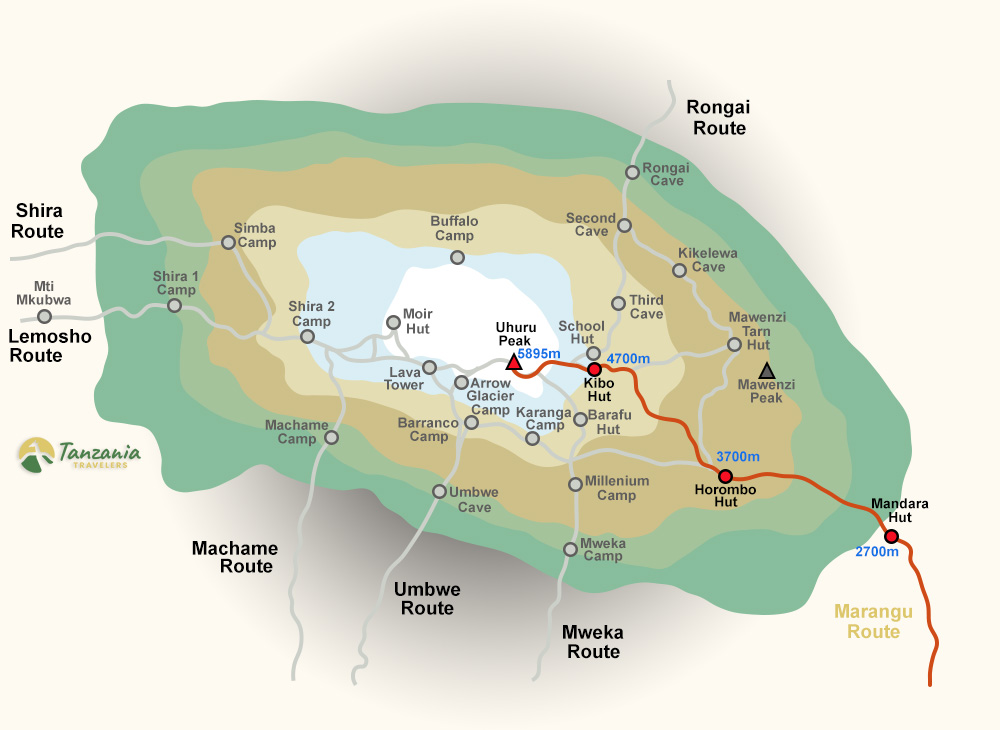
Trail map
A stylised overview of the Marangu Route, camps, elevations and summit approach.
Elevation profile
Night-by-night altitude on the Marangu Route, the shape of the climb, camp by camp.
Route FAQs
The questions climbers ask most.
Have a question about Marangu Route?
Send us your enquiry and a Tanzania-based expert will get back to you within 24 hours with a personalised itinerary, pricing for your group size and answers to any questions you have.
- No deposit required to receive a quote
- Free date & itinerary changes before booking
- Direct reply from a real human, never a chatbot