June – October
ExcellentDry season
Cool, clear mornings on the rim and easy game viewing on the floor. Vegetation is short and animals gather at water. Busiest months, so an early descent matters.


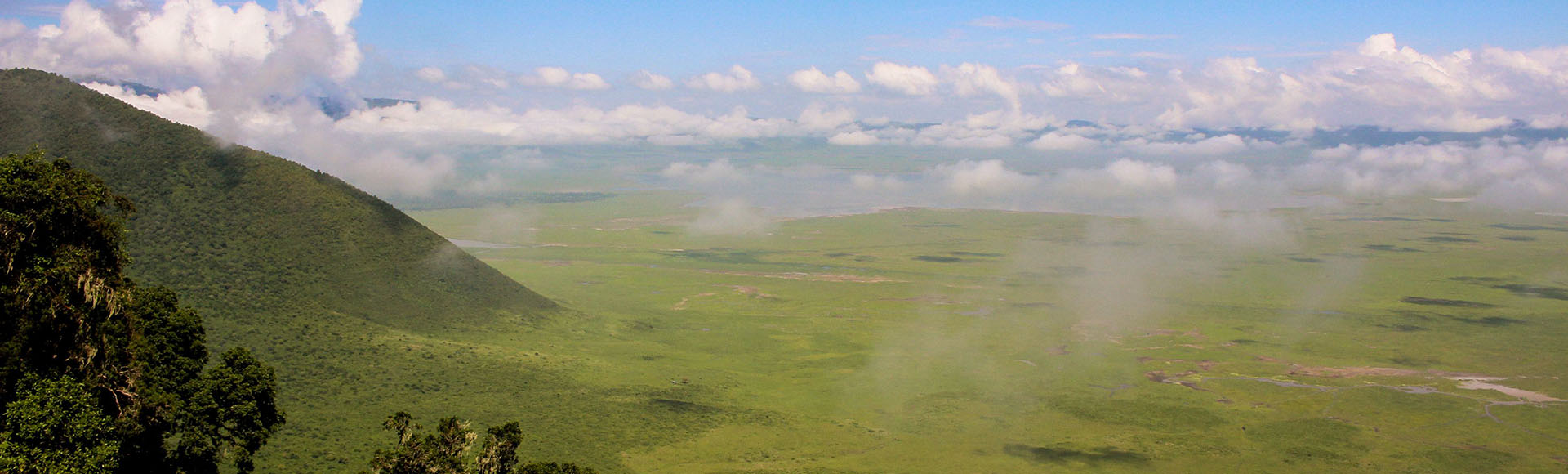
A collapsed volcano holding roughly 25,000 large animals on a single flat floor, and northern Tanzania's best chance of seeing black rhino in the wild.
Ngorongoro is a caldera: millions of years ago a large volcano collapsed inward, leaving a flat bowl enclosed by steep walls. Wildlife has lived inside that bowl ever since, with permanent water, open grazing and forest all within a few kilometres of one another. The result is game viewing unlike anywhere else in Tanzania, you rarely drive far between sightings.
The crater sits inside the Ngorongoro Conservation Area, a UNESCO World Heritage site where Maasai families still graze cattle on the highlands around the rim. Because vehicles are only allowed on the floor for a limited period each day, a descent is planned as one focused morning drive rather than a full day of driving.
The crater is one of the few places in Tanzania where black rhino are seen with any regularity, usually at distance on the open floor in the early morning.
Several resident prides live on the floor. Because the caldera walls limit movement, lions here are habituated to vehicles and often seen hunting in daylight.
Old bull elephants with heavy tusks favour the Lerai Forest, while buffalo herds graze the grasslands in their hundreds.
Lake Magadi turns pink with lesser and greater flamingos when water levels are right, alongside crowned cranes, kori bustard and raptors on the rim.
Wild dog and cheetah are largely absent from the floor, and leopard stay in the rim forest, so the crater is best thought of as a superb half-day of dense plains game rather than a replacement for the Serengeti.
Short-grass plains where most game drives happen. Lion prides, huge buffalo herds, zebra, wildebeest, Grant's and Thomson's gazelle and spotted hyena are all seen in the open.
A shallow soda lake in the middle of the floor. After rain it fills and draws flamingos, along with hippo in the nearby pools and springs.
Yellow-barked fever trees on the southern floor, the place to look for big-tusked bull elephants sheltering in the shade, plus baboon and waterbuck.
Spring-fed wetlands with hippo pools and a picnic site on the eastern floor. Elephant and buffalo come down to drink through the middle of the day.
Unlike the migration in the Serengeti, crater wildlife does not leave, the animals live inside the caldera all year. What changes is the weather, the vegetation and how many vehicles you share the descent road with.
Cool, clear mornings on the rim and easy game viewing on the floor. Vegetation is short and animals gather at water. Busiest months, so an early descent matters.
Brief afternoon showers, green grass and fewer vehicles. Excellent birding as migrant species arrive, and calves start appearing on the floor.
A drier window between the rains that pairs perfectly with the calving season on the nearby Ndutu and southern Serengeti plains.
The greenest and quietest time. Rain can be heavy in April, but the crater floor drains well and the rim views after a storm are spectacular.
Month-by-month detail for the whole country is in our best time to visit Tanzania guide.
Ngorongoro is charged differently from other parks. There is a conservation-area entry fee per person per day, plus a separate crater-descent fee charged per vehicle, and both attract VAT. Rates are set by the authorities and change from time to time, so we quote them live rather than publishing a figure that may be out of date.
Every price shown on our safari pages already includes the conservation and crater fees with VAT, full-board accommodation, a private 4×4 with driver-guide and airport transfers, there is nothing extra to pay at the gate.
See the full safari cost breakdownEvery one of our northern-circuit safaris descends into the crater. All are private departures with a 4×4 Land Cruiser, an English-speaking driver-guide and all park, conservation and crater fees included.
| Itinerary | Duration | Other parks | 2 travellers | 6 travellers |
|---|---|---|---|---|
| 3 Days Safari | 3 Days | Tarangire, Lake Manyara | USD 1,500 | USD 1,100 |
| 4 Days Safari | 4 Days | Tarangire, Serengeti | USD 2,300 | USD 1,860 |
| 5 Days Safari | 5 Days | Tarangire, Serengeti | USD 2,570 | USD 2,100 |
| 6 Days Safari | 6 Days | Tarangire, Serengeti | USD 3,195 | USD 2,300 |
Prices are per person in USD. Compare durations side by side in our Tanzania safari itineraries comparison.
The Ngorongoro Crater is the world's largest intact, inactive volcanic caldera. It formed when a large volcano collapsed in on itself, leaving a flat floor of roughly 260 km² enclosed by walls that rise around 400–600 m. It sits inside the Ngorongoro Conservation Area, a UNESCO World Heritage site in northern Tanzania.
The crater floor supports roughly 25,000 large animals. Because the caldera walls concentrate wildlife in a small area, it offers one of the highest densities of game anywhere in Africa.
All five are present. Lion, elephant and buffalo are seen on most descents, black rhino are possible on the open floor, and leopard live in the rim forest but are the hardest of the five to spot here.
Vehicles are permitted on the crater floor for a limited period, so a descent is planned as one full morning to early-afternoon game drive. We start at dawn from the rim to be among the first vehicles down.
The crater is good all year. June to October is driest and easiest for game viewing, January and February give a dry window that combines well with the Serengeti calving season, and March to May is green, quiet and best for photography of the rim.
It is roughly 180 km west of Arusha, about a three to four hour drive on tarmac and then gravel. Almost every northern-circuit safari reaches it by road, often after a night in Tarangire or Lake Manyara.
Ngorongoro carries a conservation-area fee plus a separate crater-descent fee for the vehicle, and both change from time to time. Every price on our safari pages already includes those fees with VAT, see the Tanzania safari cost guide for the full breakdown of what you pay for.
Accommodation is on the rim or just outside the conservation area, there are no lodges on the crater floor. Sleeping on the rim means a shorter drive to the descent road and a much better chance of being first down in the morning.
Yes, and they sit side by side. A common pattern is Tarangire, then the Serengeti for two or more nights, then a final morning in the crater on the way back to Arusha.
Tell us your dates and group size and we will suggest where to sleep on the rim, how to time the descent, and how to combine the crater with the Serengeti and Tarangire.